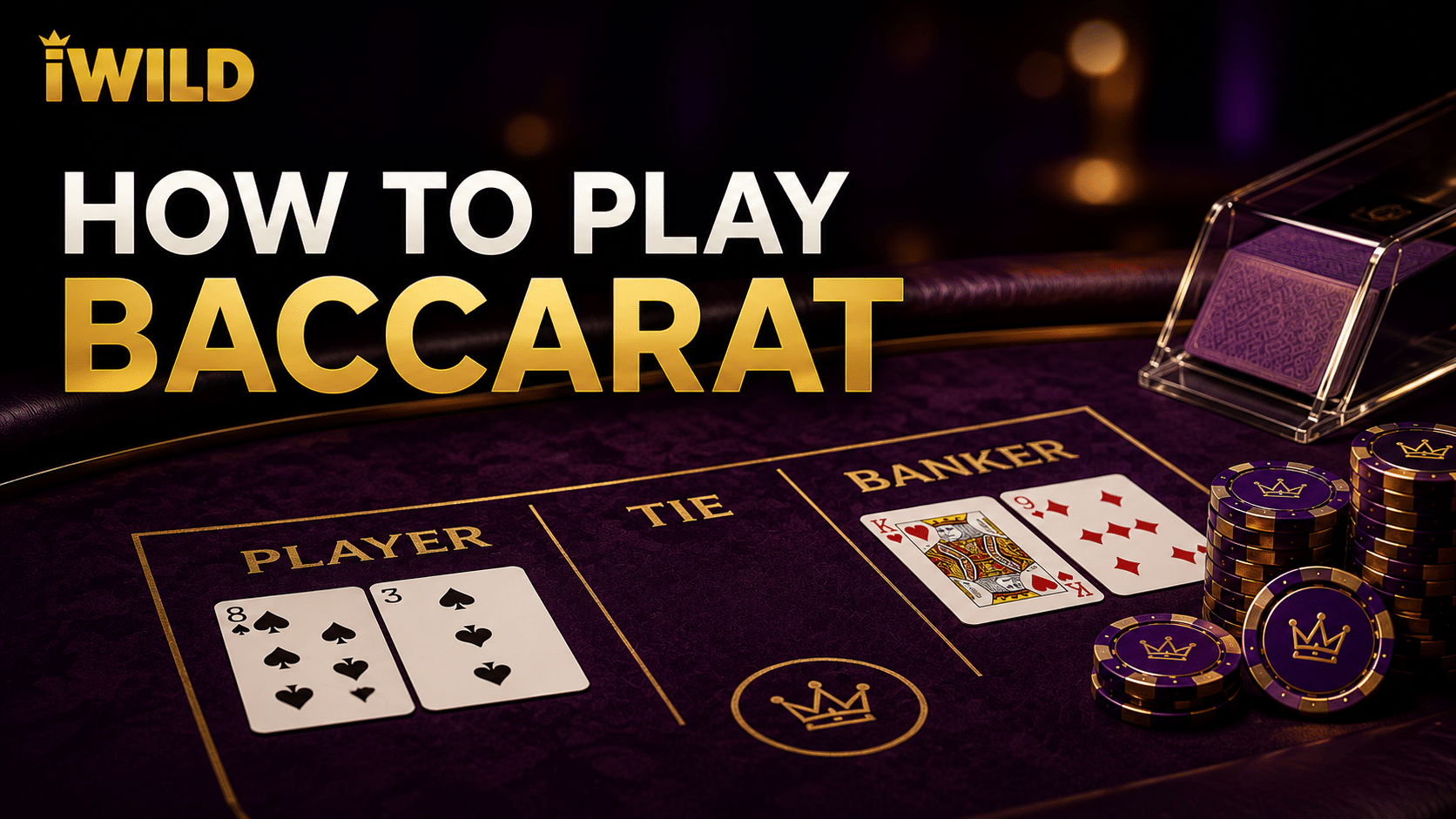
Baccarat is refreshingly simple compared to most casino games: once you place your bet, you make no further decisions, and every card is drawn automatically using fixed dealer rules.
That’s what makes Baccarat unusual—and beginner-friendly. In this iWild Casino guide, you’ll learn the objective, how each round works, the third-card rule, all betting options, and key outcomes like a push, so you can play with clarity and confidence from the start.
Baccarat Basics
Before getting into the flow of a round, it helps to understand the core ideas behind the game. The sections below cover the objective, the table, and card values.
Together, these basics explain what’s actually happening before a single card is dealt.
The Objective — Getting Closer to 9
The goal in Baccarat is simple: two hands are dealt, called Player and Banker, and you bet on which one will be closer to 9.
If a hand’s total goes above 9, only the second digit counts. For example, 15 becomes 5. This single rule explains every hand value in the game, so it’s worth understanding clearly before moving on.
The Table Layout and Who’s Who
A Baccarat table may seat 12 to 14 players, but only two hands are ever dealt: Player and Banker.
One key point: betting on “Banker” does not mean betting on the house. It’s simply the name of one of the two hands, and any player at the table can choose to bet on it.
Card Values in Baccarat
Card values in Baccarat are straightforward. Cards 2 through 9 count at face value, 10s and face cards count as 0, and Aces count as 1.
This is different from blackjack, where face cards are worth 10. Always remember: only the rightmost digit of any total is used to determine the final hand value.
How a Round of Baccarat Actually Plays Out
This section walks through a full round step by step, from the initial deal to whether a third card is drawn.
It may look complex on paper, but in practice, everything is handled automatically by the dealer.

The Deal — Two Hands, Four Cards
Once all bets are placed, the dealer gives two cards to both the Player and Banker hands.
If either hand totals 8 or 9 immediately, it’s called a “natural.” Both hands stand, and no additional cards are drawn regardless of the other hand.
When a Third Card Is Drawn
The third-card rule is fixed and can’t be influenced by the player, which is why it often confuses beginners at first.
If the Player’s hand totals 5 or less, a third card is drawn. If it totals 6 or 7, the Player stands. This only applies when neither hand has a natural.
The Banker’s action depends on its own total and sometimes the Player’s third card. You don’t need to memorise every scenario, since the dealer applies these rules automatically, but it’s important to know the system is fixed, not based on judgment.
How the Winning Hand Is Decided
After all cards are dealt, the final totals of both hands are compared.
The hand closest to 9 wins. There are three outcomes: Player wins, Banker wins, or a tie, and each result pays differently depending on your original bet.
Betting Options — Player, Banker, and Tie
In Baccarat, betting is the only decision you actually make during the game.
The sections below explain each option, including payouts and the trade-offs involved.
Betting on Player
A Player bet means you’re wagering that the Player hand will have the higher total.
It pays 1 to 1, with no commission taken. While Banker has slightly better odds, many players like this option for its simplicity and clean payout.
Betting on Banker
A Banker bet means you’re backing the Banker hand to win, and it’s generally considered the strongest option in the game.
It pays 1 to 1, but a 5% commission is taken on wins. This small fee exists because the Banker hand has a slight built-in advantage due to the fixed drawing rules.
The commission is handled automatically by the dealer, so you don’t need to calculate anything yourself.
Betting on Tie
A Tie bet means you’re betting both hands will finish with the same total.
It usually pays 8 to 1, sometimes 9 to 1 depending on the table. While the payout is higher, ties are rare, which makes this the riskiest option.
Types of Baccarat You’ll Find at a Casino
There are a few main versions of Baccarat, but most players will encounter just one or two regularly.
Punto Banco is the standard version found in most casinos and online, with fixed rules and the casino banking the game. Mini Baccarat uses the same rules but is faster and played at lower stakes.
Chemin de Fer and Baccarat Banque are less common and involve players taking a more active role, including acting as the banker.

A Brief History of Baccarat
Baccarat has been around for centuries and remains one of the most popular table games worldwide.
It’s also well known in pop culture, especially as James Bond’s game of choice in Casino Royale, adding to its reputation as a classic casino staple.
Common Mistakes to Avoid
Because Baccarat is so simple, most mistakes don’t come from misunderstanding rules but from poor money management.
The section below highlights the most common and costly issue players face.
Chasing Losses
Chasing losses means increasing your bets after losing in an attempt to recover quickly.
This approach doesn’t improve your odds, since each round is independent. A more reliable approach is sticking to a set budget and consistent bet size, rather than reacting emotionally to short-term results.
What Happens If You Can’t Finish a Hand — Splits, Ties, and Ejections Explained
In Baccarat, outcomes are tightly defined, so even edge cases are handled cleanly without confusion. The most common scenario is a tie: if you bet on Player or Banker and both hands finish with the same total, your original stake is returned. This is called a push, meaning it’s neither a win nor a loss, and no commission is charged.
It’s worth noting that a “push” in Baccarat refers specifically to this tie outcome for Player and Banker bets. It’s not a separate rule or event—it’s simply the standard result when neither side wins.
As for the flow of the game, running out of cards mid-round is extremely unlikely due to the number of decks used. If it did happen, the dealer would reshuffle and continue the game rather than canceling the hand.
These rules exist to keep Baccarat consistent and predictable. Every situation has a clear resolution, so you’re never left guessing what happens next.
Frequently asked questions
Your stake is returned with no win or loss. This outcome is called a push, meaning your original bet comes back to you.
No commission is applied, since the bet didn’t resolve as a win for either side.
The Banker bet is generally considered the best option. It has the lowest house edge in the game.
Even with the 5% commission on wins, it still offers slightly better long-term odds than the Player bet.
The objective is to bet on which hand will be closest to 9. The two hands are called Player and Banker.
You’re not trying to control the cards, just predict which hand will end with the higher total.
No, you don’t make any decisions after placing your bet. The rest of the round is fully automatic.
All cards are drawn according to fixed rules that the dealer follows every time.
The commission exists because the Banker bet has a built-in advantage. This comes from how the drawing rules are structured.
The 5% fee helps balance that edge, keeping the game fair for both the player and the casino.

