Roulette is one of the simplest casino games to learn, and one of the most transparent when it comes to odds, since every bet’s probability is fixed and clearly shown on the table. That makes it a great starting point for new players.
In this iWild Casino guide, you’ll learn how the wheel and table work, what each bet really pays, which version to choose, and how the house edge affects your results over time.
Understanding the Roulette Wheel and Table Layout
The roulette wheel is a spinning disc with numbered pockets, usually 37 or 38 depending on the version. The numbers alternate between red and black, with one or two green pockets for zero. This layout is what creates the game’s odds, while the casino also offers a range of other games for players to explore.
A small ball is dropped onto the spinning wheel in the opposite direction. As the wheel slows, the ball settles into a single pocket. That final position determines the winning number, its color, and any group it belongs to.
The colors aren’t just visual—they directly power some of the most common bets you’ll place.
The Betting Table Explained
The betting table, also called the felt layout, is where every possible wager is displayed. It mirrors the structure of the game, showing exactly where and how you can bet.
In the center, you’ll see the number grid from 1 to 36 arranged in rows of three. This is where inside bets are placed. Around it are sections for outside bets like red/black, odd/even, high/low, dozens, and columns.
It may look complex at first, but each spot represents one specific bet. Once you understand that mapping, the table quickly becomes intuitive.
Types of Roulette Bets and What They Pay
Roulette bets fall into two main categories: inside and outside. The key difference is simple—inside bets offer higher payouts with lower odds, while outside bets win more often but pay less. Understanding this trade-off is the foundation of every decision you make at the table.
Inside Bets
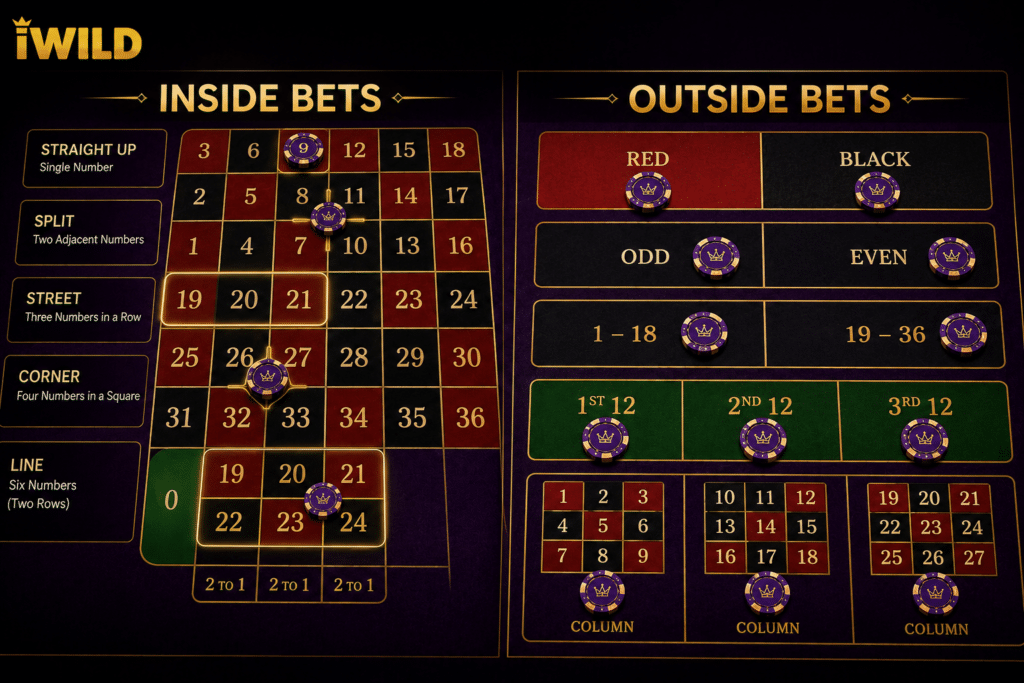
Inside bets are placed directly on specific numbers or small groups within the main grid. They offer the highest payouts in roulette, but come with a lower chance of winning.
Here are the main types:
- Straight Up: A single number, pays 35 to 1
- Split: Two adjacent numbers, pays 17 to 1
- Street: Three numbers in a row, pays 11 to 1
- Corner: Four numbers forming a square, pays 8 to 1
- Line (Double Street): Six numbers across two rows, pays 5 to 1
These are the bets that create the big, memorable wins roulette is known for. However, because they land less frequently, they’re usually best kept as a smaller part of your overall betting strategy.
Outside Bets
Outside bets are placed on the outer sections of the layout and cover larger groups of numbers. They trade lower payouts for more consistent wins, making them ideal for beginners.
Common outside bets include:
- Red or Black, Odd or Even, High or Low: Pay 1 to 1 with nearly 50% win probability
- Dozens and Columns: Cover 12 numbers and pay 2 to 1
These bets are often the starting point for new players, as the steady win rate makes it easier to follow the game and build confidence.
Bet Payouts and Odds at a Glance
This table gives you a quick, side-by-side view of every major bet type, including payouts and win probabilities on a European wheel. It’s designed to help you compare risk and reward at a glance without jumping between sections.
| Bet Type | Payout | Win Probability (European) | Risk Level |
| Straight Up | 35 to 1 | 2.7% | Very High |
| Split | 17 to 1 | 5.4% | High |
| Street | 11 to 1 | 8.1% | High |
| Corner | 8 to 1 | 10.8% | Medium-High |
| Line (Double Street) | 5 to 1 | 16.2% | Medium |
| Dozen / Column | 2 to 1 | 32.4% | Medium-Low |
| Red / Black | 1 to 1 | 48.6% | Low |
| Odd / Even | 1 to 1 | 48.6% | Low |
| High / Low | 1 to 1 | 48.6% | Low |
American vs European vs French Roulette — Which Should You Play
This is the most important decision you’ll make before placing a bet. The type of wheel you choose has a bigger impact on your long-term results than any single betting choice.
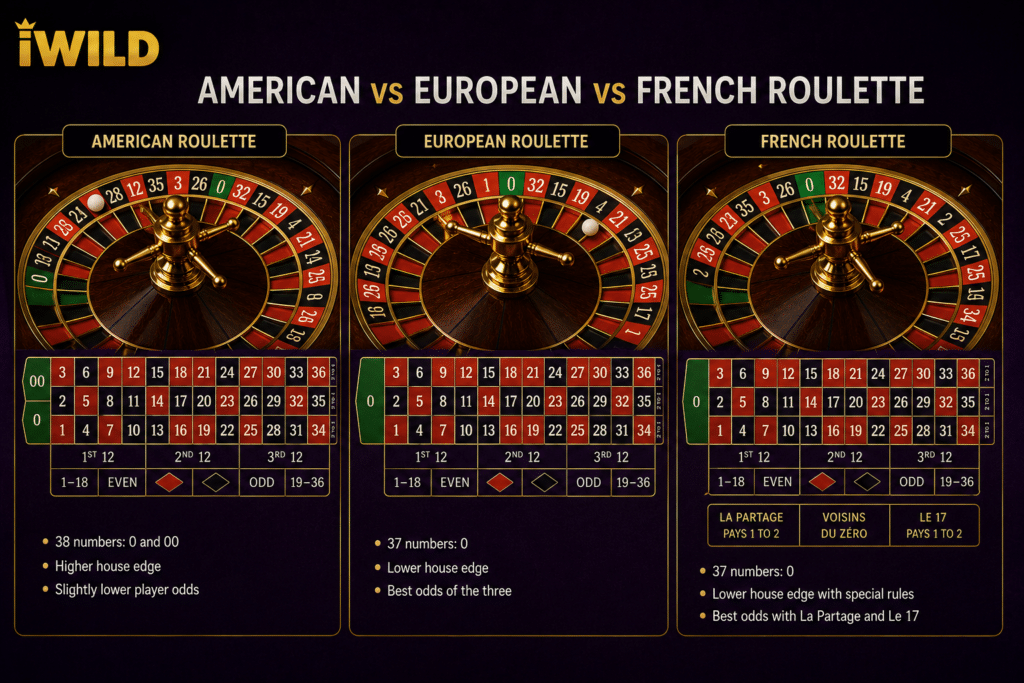
The key difference is the number of zero pockets. American Roulette includes both 0 and 00, while European and French use only a single zero. That extra pocket in the American version nearly doubles the house edge.
French Roulette uses the same wheel as European but adds La Partage and En Prison. These rules reduce losses on even-money bets, giving it the lowest house edge available.
If you have the choice, European or French Roulette should always be preferred over American.
| Feature | European | American | French |
| Pockets | 37 (0–36) | 38 (0, 00, 1–36) | 37 (0–36) |
| House Edge | 2.7% | 5.26% | 1.35% (on even-money bets) |
| Single Zero | Yes | Yes | Yes |
| Double Zero | No | Yes | No |
| La Partage / En Prison | No | No | Yes |
| Best For | Beginners, balanced play | Higher risk gameplay | Lowest edge, strategic players |
How to Play Roulette, Step by Step
This is the full flow of a roulette round, from buying chips to collecting winnings. It brings everything together into a simple sequence you can follow in real time at the table.
Step 1: Buy Your Chips
At a live table, you buy roulette chips directly from the dealer, not the cashier. These chips are color-coded and only valid at that specific table.
They must be exchanged back before leaving. In online roulette, this step is skipped, and you simply choose your stake size on screen.
Step 2: Place Your Bets
You place bets by positioning chips on the relevant areas of the table layout. You can combine multiple bets in a single round.
The dealer will announce when betting is closed. After that point, no chips can be added, removed, or adjusted.
Step 3: Watch the Spin
Once betting closes, the dealer spins the wheel and releases the ball. From this moment on, the outcome is completely out of your hands.
This is your time to watch and learn, as nothing you do can influence where the ball lands.
Step 4: Collect Your Payout
When the ball settles, the dealer announces the winning number and clears losing bets. Winning bets are then paid out based on their odds.
After payouts are complete, a new round begins immediately following the same sequence.
Popular Roulette Betting Systems
Roulette betting systems don’t change the house edge or the outcome of any single spin. Every spin is independent, with fixed odds no matter what happened before.
These systems are used to structure how you bet, helping manage bankroll swings and pacing. Think of them as tools for discipline, not ways to beat the game mathematically.
Martingale, Paroli, D’Alembert, Fibonacci, and Labouchere
Each system approaches bet sizing differently, but all aim to manage risk rather than eliminate it.
Martingale: doubles your bet after every loss, aiming to recover all losses with one win. It can work short term, but long losing streaks can drain your bankroll quickly.
Paroli: does the opposite, increasing bets after wins. This makes it lower risk, since you’re mostly betting with profits rather than chasing losses.
D’Alembert: adjusts more gently, increasing by one unit after a loss and decreasing by one after a win. It’s slower and more controlled than Martingale.
Fibonacci: follows a number sequence, moving forward after losses and stepping back after wins. It creates a structured, gradual progression.
Labouchere: uses a sequence of numbers to define your betting targets. You adjust the sequence as you win or lose until it’s cleared.
Most of these systems are used on even-money outside bets, where consistent probabilities make the progression easier to apply.
Recommended Bets for Beginners
The best place to start in roulette is with outside bets like red/black, odd/even, and high/low. These offer close to a 50% win probability, making them easier to follow while learning the flow of the game.
They won’t deliver big single wins, but they help extend your playing time and build confidence. As you get comfortable, you can add a few small inside bets for variety, as long as they stay a minor part of your total bankroll.
Common Mistakes to Avoid
One common mistake is spreading chips across many individual numbers, hoping something hits. Even when you win, the payout often doesn’t cover the total amount staked.
Other errors include ignoring table limits, chasing losses without a plan, and choosing American Roulette without realizing the higher house edge. European or French tables usually offer better value for the same gameplay.
Table Etiquette Every First-Timer Should Know
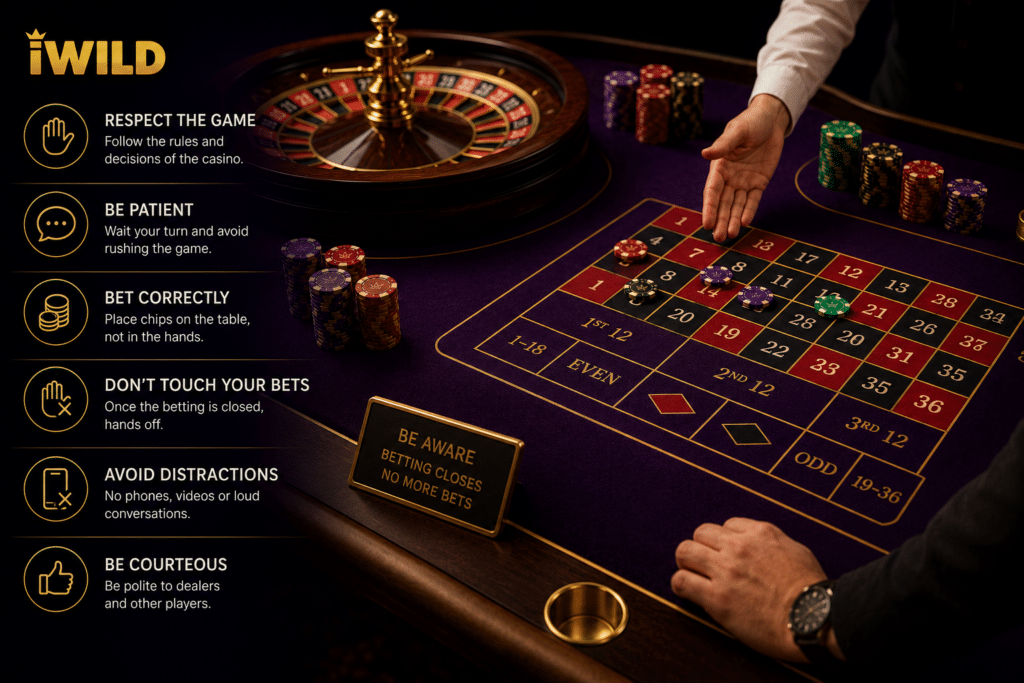
At a physical roulette table, timing and awareness matter. Never touch chips once the dealer calls “no more bets,” and avoid reaching over the table during a spin.
After the result, the dealer places a marker (called a dolly) on the winning number. This means no chips should be moved until payouts are complete. If you’re unsure, ask—the dealer will guide you.
Online vs In-Person Roulette
Online roulette is faster and lets you control the pace, while in-person play follows the dealer and adds a social element. Each has its own appeal depending on your style.
Online platforms offer lower minimum bets and easy access to multiple versions. Physical casinos require travel and may have limited options, but provide a more immersive experience.
What a 2.7% House Edge Actually Costs You — A Real Session Example
The house edge isn’t something you feel on a single spin. Each spin is independent, and anything can happen in the short term. The edge only shows up as an average over many spins.
For example, if you place $10 even-money bets on a European wheel with a 2.7% house edge over 100 spins, you’re wagering $1,000 total. On average, the expected loss is about $27 over that session.
Now compare that to American Roulette with a 5.26% edge. The same 100 spins at $10 per bet would result in an average loss closer to $53.
This difference adds up quickly over time. It’s why choosing the right wheel has a bigger long-term impact than any betting system you use.
Frequently asked questions
Roulette follows a simple bet–spin–payout cycle. You place chips on the table, the wheel is spun, and winning bets are paid based on where the ball lands. The zero pocket isn’t covered by even-money bets, which creates the house edge.
The safest bets in roulette are even-money outside bets. These include red/black, odd/even, and high/low, each offering close to a 50% chance of winning. They don’t pay much, but they provide the most consistent results.
The best bets for beginners are outside bets. They’re simple to understand and easy to track, with near-even odds that make the game feel more predictable while you learn how rounds flow.
Roulette payouts depend on how many numbers your bet covers. The fewer numbers included, the higher the payout if you win. This is why single-number bets pay the most, while broader bets pay less.
No, there is no strategy that can beat roulette in the long run. Every spin is independent with fixed odds, and the house edge remains constant regardless of previous results or betting systems.

