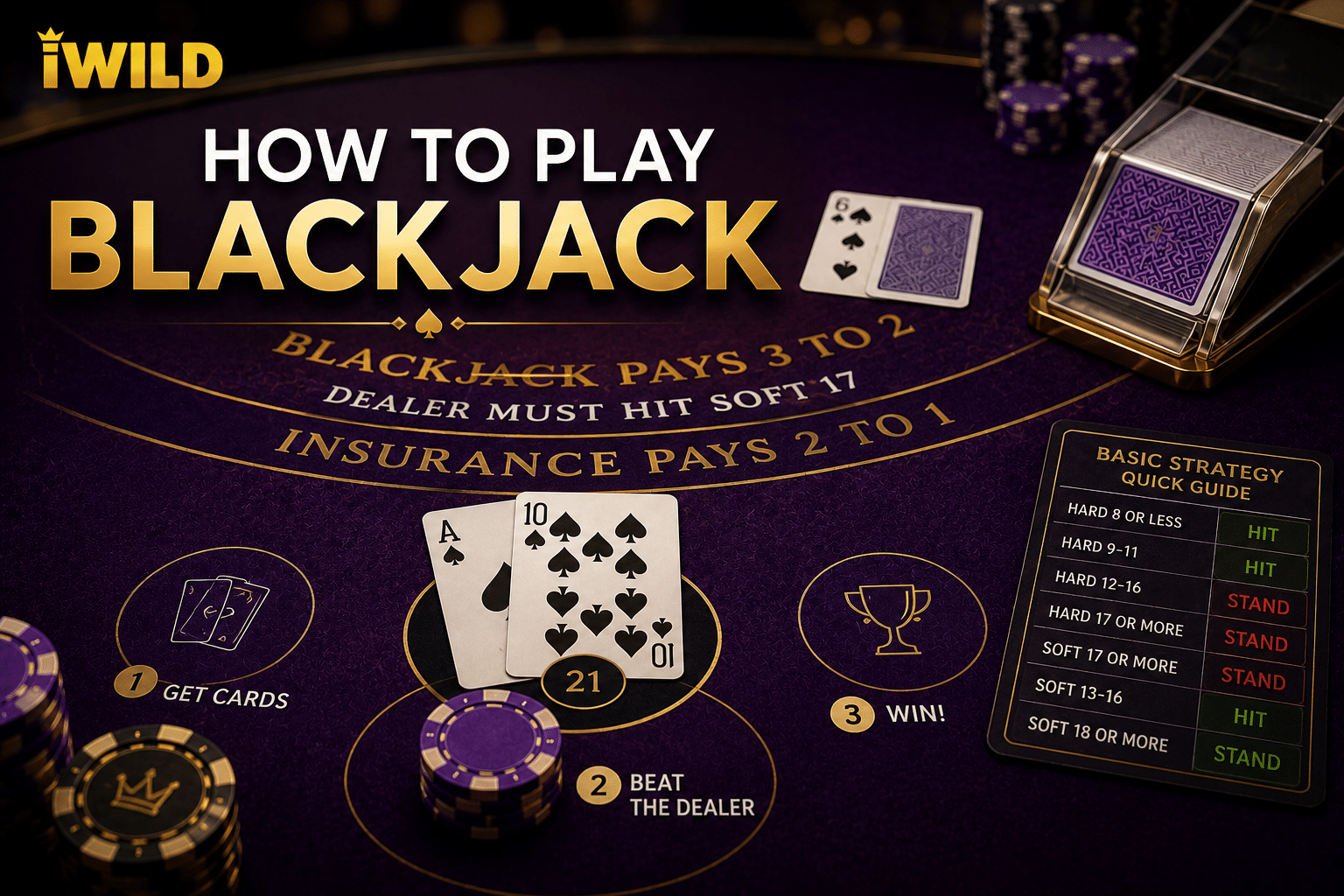
Blackjack is one of the easiest casino games to learn and one of the few where your decisions genuinely influence the outcome. Unlike pure chance games, the choices you make at the table can shift the odds in your favor over time. This guide is built for complete beginners and covers everything you actually need to know: the rules, every move available, basic strategy, and the real-world table conduct that most guides skip but players quickly realize matters.
Blackjack Rules — How a Hand Actually Plays Out
Blackjack may seem complex at first, but the structure of a hand is straightforward once you break it down. Each round follows the same predictable flow, from betting to payout. The sections below explain the objective, card values, and the sequence of play, while online promotions may be available separately.
The Objective — Beating the Dealer, Not Just Reaching 21
The biggest beginner mistake is thinking the goal of Blackjack is simply to reach 21. It isn’t. The real objective is to beat the dealer by having a hand closer to 21 without going over. You can win with 17 if the dealer has 16 or busts, and you can lose with 20 if the dealer has 21. Reaching 21 is the strongest possible hand, but it’s not required to win—it just gives you the best position.
Card Values at a Glance
Card values in Blackjack are simple: number cards count as their face value, face cards (Jack, Queen, King) are all worth 10, and the Ace can count as either 1 or 11 depending on what benefits your hand. For a deeper explanation, including soft and hard hands, check iWild Casino’s full card values guide.
How a Round Unfolds, Deal to Payout
A round starts with you placing your bet. You then receive two cards face up, while the dealer gets two cards—one face up and one face down. You decide how to play your hand using available actions, and once all players act, the dealer reveals their hidden card. The dealer must follow fixed rules, hitting until reaching at least 17. Some tables require the dealer to hit on a soft 17, while others require them to stand.
Once all hands are complete, results are settled. Standard winning hands pay even money (1:1). A natural Blackjack—an Ace plus a 10-value card—usually pays 3:2, though some tables offer a reduced 6:5 payout, which is less favorable. If you and the dealer tie, it’s a push, and your original bet is returned.
Player Actions — Every Move You Can Make
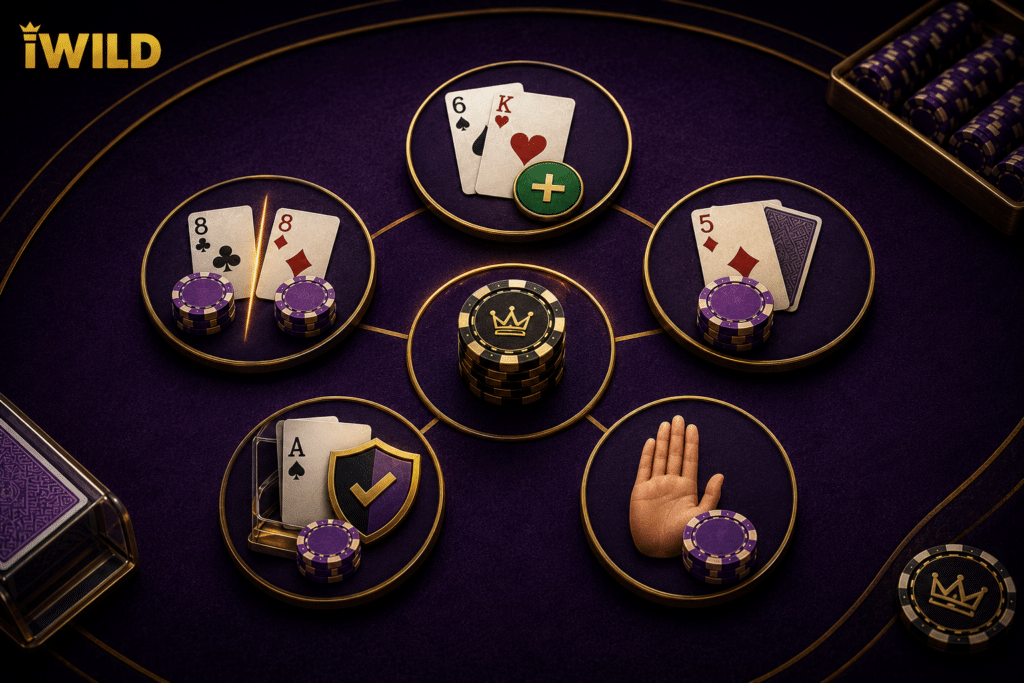
Once you see your first two cards, Blackjack becomes a game of decisions. Every action you take affects the outcome. This section is a complete guide to your options, and the H3s below explain each move clearly so you can use them confidently at the table.
Hit or Stand
Hit and stand are the two core actions in every hand. Hitting means taking another card because your total isn’t strong enough yet. Standing means keeping your current hand and ending your turn.
This decision happens every round. All other actions are situational, but hit or stand is always available and forms the foundation of your Blackjack strategy.
Splitting Pairs
If your first two cards have the same value, you can split them into two separate hands. Each hand gets a new card and requires an extra bet equal to your original wager.
Most tables restrict split Aces. You usually receive only one additional card per Ace, with no option to hit again afterward.
Doubling Down
Doubling down lets you increase your original bet, usually by the same amount, and receive exactly one more card. After that, your turn automatically ends.
This move is best used when one more card is likely to improve your hand significantly. Basic strategy defines these situations clearly, rather than relying on guesswork.
Insurance
Insurance is offered when the dealer’s face-up card is an Ace. You can bet up to half your original wager that the dealer has Blackjack.
If the dealer does have Blackjack, insurance pays 2 to 1. Otherwise, you lose the side bet. Despite sounding useful, basic strategy generally advises against taking insurance.
Surrender
Surrender allows you to give up your hand immediately after the deal and recover half of your original bet. The round ends without playing further.
Not all tables offer surrender. Always check the rules before relying on it, as this option only works when it is explicitly available.
Basic Strategy for Beginners
Basic strategy is the mathematically optimal way to play every Blackjack hand based on your cards and the dealer’s upcard. It’s built from computer simulations, not guesswork or superstition.
Using basic strategy can reduce the house edge to under 1% in many games. That makes it the most valuable skill a beginner can learn. The sections below break down how each decision works.
When to Hit or Stand
The dealer’s upcard is the key to deciding whether to hit or stand. It tells you how likely the dealer is to bust.
When the dealer shows a weak card (2 through 6), they’re more likely to bust. In these cases, standing on 12 or higher is often correct. Against strong dealer cards (7 through Ace), you usually need to hit up to 16, because standing gives the dealer an easy win.
This upcard-based thinking is what separates basic strategy from guessing.
When to Double Down
Doubling down works best when your chances of improving with one card are strong. This usually happens with totals of 9, 10, or 11 against weaker dealer cards.
You’re aiming to build a strong hand while the dealer is more likely to struggle. Soft hands with an Ace also have doubling opportunities, though these are less obvious and follow specific strategy rules.
When to Split Pairs
Some split decisions are always correct. You should always split Aces and 8s, as both hands improve significantly when separated.
You should never split 5s or 10s. These hands are already strong and perform better as a single total. All other pairs depend on the dealer’s upcard, as shown in the cheat sheet below.
Quick-Reference Cheat Sheet
This table is a simple reference for real gameplay. It covers hard totals, soft hands, and pairs. Use it as a quick guide before or during play rather than trying to memorise everything at once.
| Hand | Dealer Shows | Recommended Action |
| Hard 8 or less | Any | Hit |
| Hard 9 | 3-6 / Other | Double, otherwise Hit |
| Hard 10 | 2-9 / Other | Double, otherwise Hit |
| Hard 11 | 2-10 / Ace | Double, otherwise Hit |
| Hard 12-16 | 2-6 / 7+ | Stand, otherwise Hit |
| Hard 17+ | Any | Stand |
| Soft A,2 – A,9 | Varies | Double, otherwise Hit |
| Pair: Aces & 8s | Any | Split |
| Pair: 5s & 10s | Any | Never split |
| Pair: 2,3,4,6,7,9 | Varies | Spit,otherwise Hit |
Advanced Strategies Worth Knowing
Once you’re comfortable with basic strategy, there’s another layer to explore. One key idea is the difference between soft and hard hands, which affects how flexible your decisions can be.
It’s also worth knowing that betting systems don’t change the odds. Flat betting—using the same wager each hand—is generally the smartest approach, since no pattern can overcome the house edge.

How Card Counting Works — And Should You Try It?
Card counting tracks the balance of high and low cards left in the deck. High cards (10s and Aces) favor the player, so when more remain, the odds slightly improve.
It’s a legal skill because it uses only mental tracking, not devices. However, it’s difficult to do accurately at real table speed and takes serious practice. Casinos are also alert to it and can ask players to stop or leave if they suspect counting.
Common Misconceptions About Card Counting
Card counting doesn’t mean memorising every card played. It’s based on a simple running count that increases or decreases as cards are dealt.
It also doesn’t guarantee wins. It only gives a small edge over time, meaning you can still lose in the short term—even if you’re doing everything correctly.
Bankroll Management for New Players
Set a fixed budget before you start playing and stick to it. Choose a table minimum that lets you play enough hands without running out too quickly.
Treat your bankroll as entertainment spending, not an investment. Even with perfect Blackjack strategy, the house still has a small edge, so discipline is what keeps your session enjoyable.
Common Mistakes to Avoid
Many beginners stand on hard 16 against strong dealer cards because they fear busting. In reality, basic strategy often recommends hitting in that situation.
Other common mistakes include assuming all tables use the same rules, increasing bets to chase losses, and relying on instinct instead of a strategy chart. Over time, strategy consistently outperforms guesswork.
Online vs Land-Based Blackjack
Online and land-based Blackjack offer different experiences. Online games and live dealer tables usually move faster, allowing more hands per session.
Rules can also vary, with some online tables offering better payouts or conditions. Playing online removes the need for hand signals and table etiquette, since all actions are made through a simple interface.

Blackjack Table Etiquette and Hand Signals
At a physical Blackjack table, you usually don’t touch your cards once they’re dealt. Instead, every decision is communicated with hand signals so dealers, pit bosses, and cameras can clearly verify each action. This system avoids confusion and keeps the game secure, just as clear table etiquette does in roulette.
The two main signals are simple. To hit, tap or lightly scratch the table behind your bet. To stand, wave a flat hand horizontally over your cards. These gestures should be clear and deliberate so the dealer can’t misread your intent.
There are a few basic etiquette rules to follow. Place your chips before the deal starts, not during the hand. Avoid touching your chips once play begins, and don’t make unclear or rushed movements. If you’re unsure, just ask. The dealer will guide you, and it’s always better than guessing.
Frequently asked questions
A natural Blackjack beats any other 21. Any hand that doesn’t bust beats a lower dealer total, and if the dealer goes over 21, all remaining player hands win automatically. If both you and the dealer have the same total, the result is a push and your bet is returned.
No, not consistently with standard play alone. Basic strategy reduces the house edge to a very low level but doesn’t remove it entirely. Only advanced techniques like card counting can theoretically shift the edge in the player’s favor over time.
No, memorising basic strategy isn’t required to start playing. Many casinos allow players to use a printed strategy card at the table. Memorisation helps over time, but using a reference is completely acceptable for beginners.
Nothing unusual—dealers usually give you reasonable time to act. If you’re unsure, you can ask the dealer for guidance before making a move. This is common and expected, especially for new players learning the game.
Blackjack is a mix of both. The cards you receive are based on luck, but how you play them is skill. Basic strategy focuses on making the best possible decisions to improve your odds over time.

